
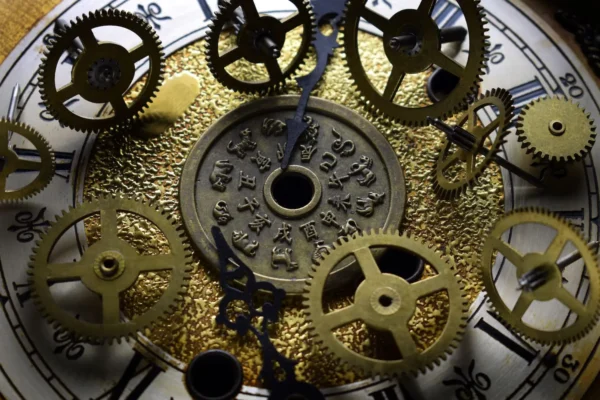
In traditional Chinese culture, as in other ancient civilizations such as the Maya, time has always been regarded as a fourth dimension of space. However, this concept did not emerge in the West until the mid-18th century, in the context of studies on geometry carried out by certain mathematicians. It was first incorporated by Jean Le Rond d’Alembert into the ‘dimension’ section of the encyclopedia, then rigorously developed by Joseph-Louis Lagrange in his analytical mechanics in 1788, before being fully formalized by Bernhard Riemann in 1854 in the form of geometry in Space.
The use of this fourth dimension (Time) has now become indispensable to modern physics, from Albert Einstein’s theory of relativity right through to quantum physics. This scientific perspective has, little by little, confirmed the views held by certain ancient cultures, which were based on observation, intuition and perhaps other reasons that remain unexplained. This concept of Space-Time still raises a great many questions and speculations today (as in Christopher Nolan’s film Interstellar), yet it still leaves humankind in the dark regarding its own origins and those of the Universe.
Feng Shui is an ancient art developed around the study of the Universe (Cosmology), nature (the Earth) and humankind. Studies and observations, carried out over thousands of years by various Chinese dynasties, have made it possible to establish a shifting/cyclical mapping of visible or subtle energies (qi) as they apply to the dimensions of space as we know it. However, as the dimension of Time was considered by these Chinese civilizations to be an integral part of Space, this mapping of energies was also applied to this complementary dimension of Time. Thus, every year, month, day and hour carries its own specific, constituent energy, which may be favorable or challenging.
This cyclical transformation of the properties of visible and subtle energies (qi) therefore involves the concept of time, which is of great importance in Feng shui (as in acupuncture or Traditional Chinese Medicine). The Chinese calendar (Tong Shu) is used to understand and identify annual, monthly and daily influences. The Chinese New Year falls in February, and the influences on the qualities of qi vary from each new year onwards, following a 60-year cycle.
A Feng Shui approach that does not take the dimension of time into account is therefore not a complete or effective Feng Shui approach. Indeed, in addition to the advice provided by a Feng Shui expert on the positioning and orientation of furniture (bed, sofa, desk, etc.), it is essential to determine the right period and the right moment for positioning these items. By way of analogy, when you want to grow a plant, it is important, depending on the type of plant, not only to choose the right spot and the right orientation, but also to choose the right time to plant it. If the timing is wrong, there is a high risk that the plant will struggle to grow, have less energy and vigor, or even wither away. The expression ‘being in the right place at the right time’ then takes on its full meaning.
In Feng Shui, when a piece of furniture (such as a bed) is positioned in a particular direction, it is said to be placed within an energy flow. If this energy flow is disruptive, then one lives (or ‘travels’) with these negative energies on a daily basis, with no time limit, as Time and Space are infinite. This is why some people may feel energetically drained in the long term, with numerous associated consequences (lack of sleep, fatigue, chronic or triggered illnesses, accidents, conflicts, etc.). The only way to break free from these situations is therefore to change trains. This change can occur involuntarily (moving house, changing beds, changing one’s position in bed) or voluntarily (moving the bed for 24 hours and repositioning it at a favorable time to board a new train that one chooses as beneficial).
To make these changes, it is important to be guided by a Feng Shui Consultant trained in authentic Traditional Chinese Feng Shui. Indeed, choosing the right dates is a complex process that takes into account direction, timing, and also the energetic constitution of the individuals involved.