

The School of Form (represented by the SAN HE School) studies the environment and its energetic impact on the home. In a Feng Shui analysis, it helps to better define the flow of energies by studying the natural and man-made forms present inside or outside a home. The School of Form is characterized by an intuitive approach.
A Feng Shui expert, drawing on the knowledge acquired during their training and through their various experiences, will sense – using their senses as well as their intuition – the best placements, potential imbalances and the actions required to correct them. In particular, they will rely on the principles developed by the School of Form, as outlined below:
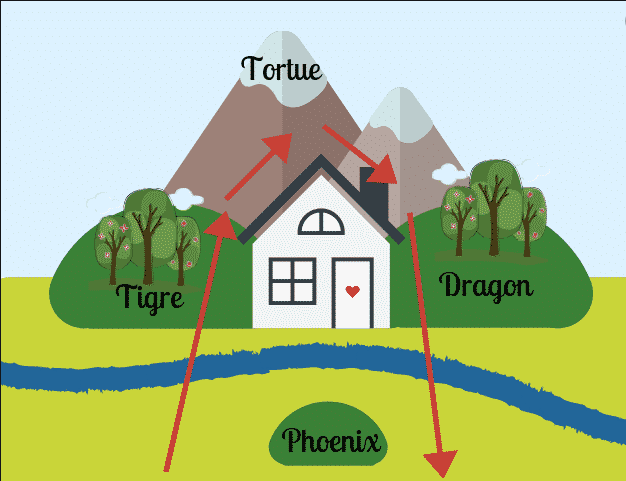
- The principle of the Four Symbols (Dragon, Tortoise, Tiger, Phoenix)
defines four types of landscape whose shape and position help to describe the configuration of Qi. Qi flows according to the contours of the land and, through its generative action, brings all living things into existence. Its movement follows the contours of the land, accumulating where the terrain breaks. The aim of Feng Shui is to optimize this fluid flow of Qi. By applying these principles of the Four Symbols to an armchair, for example, the Tiger and the Dragon represent the armrests (notion of protection), the Tortoise represents the backrest (notion of support) and the Phoenix the footrest (open, free space in front of you, with a small obstacle to deflect forces from the front). Now imagine yourself in the situations below. How would you feel, and what would be the mental impact of experiencing this feeling on a daily basis?
– One armrest missing
– A backrest where there is currently an empty space in front of you
– No backrest at the rear, just an empty space
- The principle of the Dragon’s Mark
(the Dragon’s Latch) defines the optimal positioning for benefiting from the energies of the surrounding landforms. It is determined by the intersection of the ‘territories’ of the four animals: Dragon, Tiger, Tortoise and Phoenix (four deities), as explained in the previous paragraph. It is the point towards which Qi converges. The Dragon’s Mark is found at the intersection of the river and the mountain, or of river and river, as illustrated by the positioning of the houses in the adjacent image. The intersection of water (Yang) opposite the Dragon’s Mark with the positioning of the mountains (Yin) also represents the concept of balance (Yin/Yang), which is central to the principles of Feng Shui.

- The principle of approximation and similarity
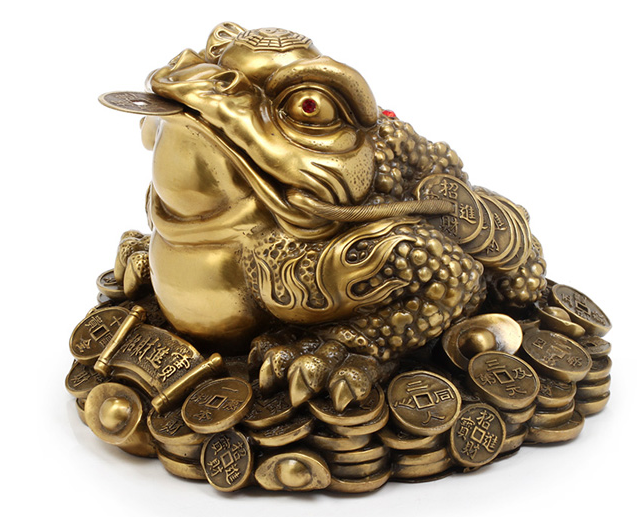
This principle highlights the concept of symbolism. Each character is a symbol, an image or a design that conveys an idea or a concept (this is the concept of potential Feng Shui). Everything invisible represents the Yin aspect; it is potential, and potential Feng Shui is realised through intuitive thinking. For example, if we place a Feng Shui symbol in a house (e.g. an animal), we imbue it with an idea. The object will be animated by our idea. This object will act to put our idea into practice and thus release the energies of our idea. This is what we might also call ‘the psychology of the home’ or ‘positive psychology’. In the example on the left, the three-legged toad, sitting on silver coins, is regarded in Chinese mythology as a symbol capable of bringing prosperity. According to Feng Shui belief, it has the power to ward off evil, protect wealth and increase income. It is therefore on the strength of this idea that the object will act accordingly to radiate or carry this idea energetically, every day. Please note that the positioning of these representations (objects, paintings, statues, photos, etc.) also has meaning and a potential impact, which requires taking into account the results of the Feng Shui compass analysis (Flying Stars method); hence the need to draw on the knowledge and experience of an expert in Traditional Chinese Feng Shui to avoid making mistakes.
- The principle of reconciliation
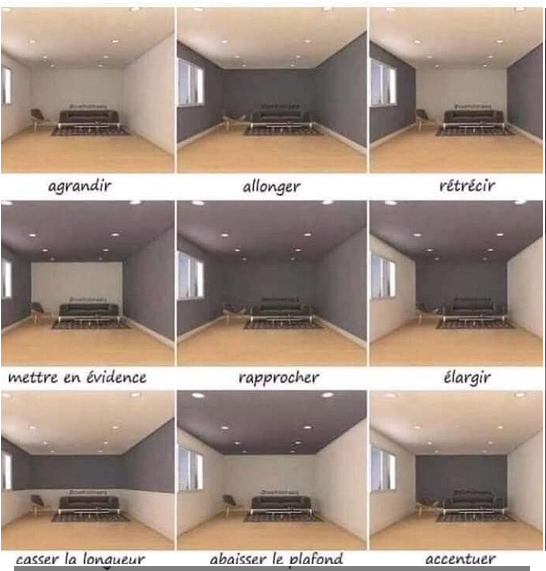
is based on the premise that any imbalance identified must be corrected. Every problem must be resolved as soon as it arises so that its harmful impact can be quickly mitigated. The aim is to restore order, in a balanced way, in order to achieve harmony through the equilibrium of Yin and Yang and by optimising the flow of Qi. For example, in the image on the right, it is possible to use wall paint to rebalance the overall impression of space. It is also possible to use colour to diminish certain difficult energies and activate certain favourable energies.